
Sunday Night Anxiety: Why It Happens and How to Gently Calm Your Nervous System Before Monday
Sunday night anxiety, often referred to as the “Sunday scaries,” is a common experience that affects people across all ages, careers, and life stages. It describes the uneasiness, restlessness, or sense of dread that arises as the weekend comes to an end and the upcoming week approaches. For some individuals, it appears as racing thoughts and difficulty sleeping. For others, it presents as muscle tension, irritability, or a heavy emotional fog.
This experience does not indicate weakness or failure. In most cases, Sunday night anxiety is a nervous system response to anticipated demand. The body continuously scans for safety. When it senses that effort, responsibility, or performance will soon be required, it may move into a protective state.
Even when Monday is logically expected to be manageable, the nervous system often reacts based on past patterns rather than present circumstances. If previous weeks involved high stress, emotional labor, or exhaustion, the body remembers and begins preparing ahead of time.
Viewing Sunday night anxiety through this lens shifts the focus from self-judgment to self-support. Rather than something to eliminate, it becomes a signal that the system is seeking regulation and care.

Why Sunday Night Anxiety Feels Stronger in the Evening
Evenings naturally bring increased internal awareness. Distractions decrease, stimulation slows, and the mind has more space to wander. If emotions or stressors have been suppressed throughout the week, Sunday evening may be the first quiet moment where they surface.
Fatigue also plays a role. When the body is tired, resilience is lower. Thoughts feel heavier, emotions feel closer to the surface, and worries intensify. This combination often amplifies anxious sensations.
Instead of resisting these feelings, it can be more supportive to approach them with curiosity. The nervous system may be communicating that it needs rest, reassurance, and gentleness.
The Role of the Nervous System
The nervous system functions through two primary states: sympathetic activation (fight-or-flight) and parasympathetic regulation (rest-and-digest). Sunday night anxiety generally reflects a shift toward sympathetic activation.
Common signs include shallow breathing, muscle tension, restlessness, and mental overactivity. These are not signs of danger. They are signs of activation.
Calming Sunday night anxiety focuses less on controlling thoughts and more on helping the body return to a regulated state. When the nervous system settles, mental clarity often follows.
Gentle Practices That Support Regulation
Slow breathing is one of the most accessible tools for nervous system regulation. Inhaling through the nose for four counts and exhaling through the mouth for six counts encourages parasympathetic activation. Even a few minutes can begin to soften anxious sensations.
Gentle movement can also be supportive. Light stretching, slow yoga, or simply lying on the floor and allowing the body to relax into gravity can release stored tension. This type of movement is not intended as exercise but as a form of self-soothing.
Creating a simple Sunday evening ritual can further support regulation. This may include making a warm beverage, dimming lights, lighting a candle, or listening to calming music. Repetition trains the body to associate Sunday evenings with safety rather than stress.
Externalizing thoughts is another helpful practice. Writing down worries and reminders without organizing or solving them allows the mind to release mental clutter. Containment often reduces intensity.
Somatic and energy-based practices such as sound baths, restorative yoga, reiki, and guided meditation can provide additional support. These modalities work directly with the nervous system and are especially helpful when anxiety feels physical rather than purely cognitive.
Exhale & Rise offers in-person classes in Houston and virtual sessions focused on nervous system regulation through sound healing, gentle movement, meditation, and energy work. These experiences are designed to be accessible and grounding for individuals experiencing overwhelm, burnout, or emotional fatigue.
Reframing the Relationship With Monday
Sunday night anxiety is frequently fueled by the belief that Monday must be approached perfectly. This pressure creates a sense of urgency and inadequacy before the week begins.
A gentler perspective is to view Monday as a continuation of life rather than a test. Instead of focusing on everything that must be handled, individuals may benefit from asking, “What is one small supportive action that can be offered tomorrow?”
Small acts of care accumulate and create internal safety.
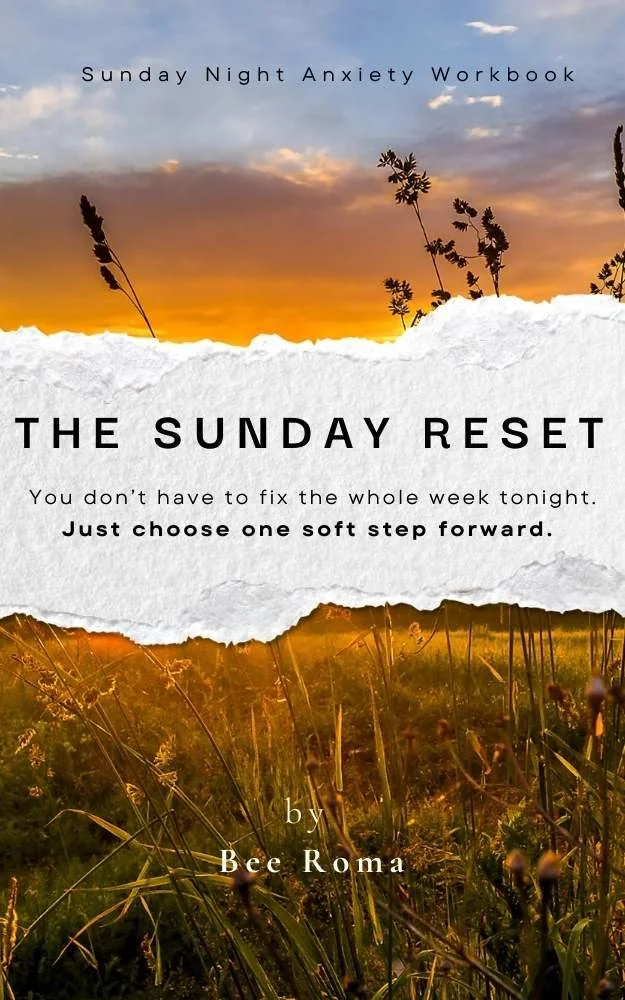
A Supportive Resource for Sunday Evenings
For individuals who experience Sunday night anxiety regularly, having a consistent resource can be helpful.
The ebook The Sunday Reset: Finding Calm Before the Week Ahead: A Workbook for Calming Sunday Night Anxiety and Carrying Peace Into Your Week offers calming practices, simple routines, reflection prompts, and nervous-system-based guidance designed specifically for Sunday evenings. It is intended as a compassionate support tool rather than a productivity guide.
Sunday night anxiety does not indicate incapability. It reflects humanity within a demanding world. With gentle support and consistent nervous system care, Sunday evenings can gradually feel softer and more manageable.